
Four hundred years after colonists from England first set foot on shore of the James River under the watchful and wary eyes of the native Powhatans, visitors to the Jamestown Settlement can explore the struggles that occurred at this confluence of river and sea, people and ideas.
As part of the team under prime contractor Design & Production, ThemeWorks created all dioramas, themed environments and scenic fabrication for the 30,000 square feet (2,787 m2) of Gallagher and Associates designed gallery space in the museum.
Working closely with Jamestown curators to ensure historical, archaeological and botanic fidelity, our team spent weeks in the estuaries and forests surrounding the James River molding trees, collecting soil samples and photographing details for reference during the fabrication process.
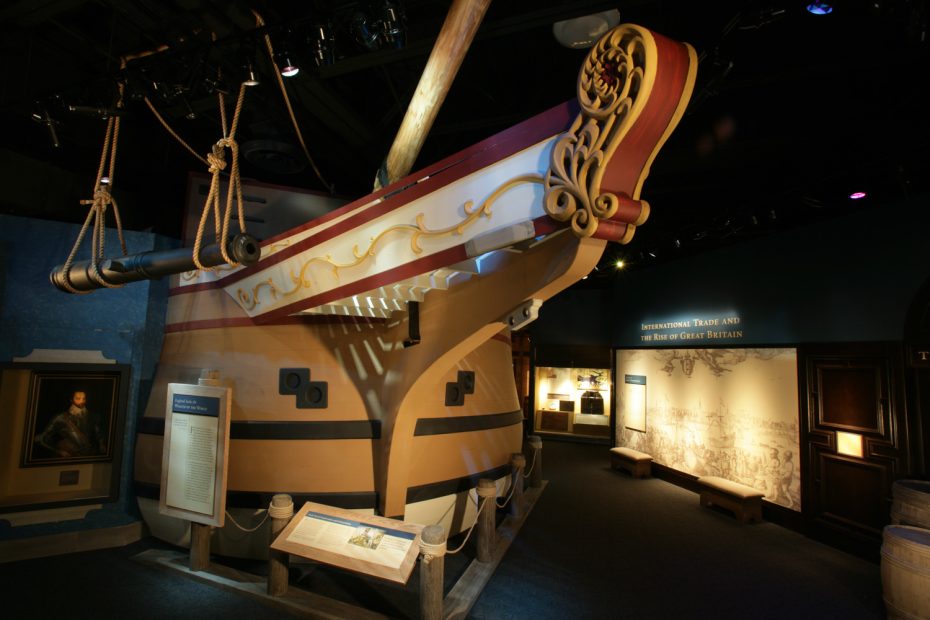
Incorporating these details into the exhibits such as a full-scale 1600s London street scene, a Powhatan forest village and a partial reproduction of the ship Susan Constant adds layers of realism and helps set the stage for the museum’s guests’ exploration of Jamestown’s complex and fascinating history.
PROJECT DETAILS
Project: Jamestown Settlement Museum
Designer: Gallagher and Associates
Client: Design & Production, Inc.
Size: 30,000 square feet (2787 m²) of exhibit space
Photography: LeGrand Photography
Scope of Work: ThemeWorks created all dioramas, themed environments, and scenic fabrication for the 30,000 square feet of gallery space in the new museum.
Notable scenic dioramas include a 17th century London street, a pre-European arrival Powhatan dwelling and surrounding environs, an Angolan dwelling, and a full scale replica of one of the first ships to arrive with settlers, the Susan Constant.
The London street scene features pegged timber construction and period plaster over lath, diamond light lead caned windows and authentic interior detailing such as linenfold panel wainscoting.
The Powhatan diorama is a realistic depiction of a wooded scene on the banks of the James River, featuring numerous artificial trees, shrubs, fabricated corn and bean plants and a simulated tidal creek.
The Angolan diorama features an authentic recreation of an Angolan stick and mud hut, a Baobab tree with seed pods and cultivated plants including corn, beans and manioc.
Other components included a hand-hewn oak tobacco barn complete with fabricated “hands” of tobacco, split-rail fencing, palisade fencing, numerous props, English bond brickwork and scenic painting on several facades.
Life cast figures, graphics, AV, casework, yehakin, and other components were produced by either the Owner or Design & Production.